
Sponsorship starts with a promise: one party provides money, products, services, or promotional support, and the other delivers agreed visibility or access to an audience. Problems usually begin when that promise stays vague. “Gold sponsor” sounds impressive, but it does not explain where a logo will appear, how many posts will be published, or what happens if the event is canceled.
A well-written sponsorship agreement turns the pitch into a workable plan. The five examples below can help event organizers, nonprofits, sports clubs, creators, schools, conferences, media projects, and businesses identify the terms they need. Four items refer to external sources; the final editable template is hosted on this site.
This guide is educational, not legal, tax, advertising, or accounting advice. Sponsorship rules and contract law vary by location and industry. Have a qualified local professional review the finished agreement, particularly where children, alcohol, gambling, healthcare, financial products, endorsements, charitable status, data, or broadcast rights are involved.
Before You Draft: Write the Deal in Plain English
Imagine explaining the arrangement to a colleague who missed every meeting. Could that person answer these questions?
- Who provides what, how much, and by when?
- What exact benefits does the sponsor receive?
- Which event, season, campaign, channel, or territory is covered?
- How long does the arrangement last?
- Who approves logos, messages, and public announcements?
- How will success be measured?
- What happens if plans change?
Write those answers first. They form the commercial backbone of the contract and reveal gaps before legal language makes the draft harder to read.
Identify Every Party and Decision Maker
Use the full legal name, organization type, registered or principal address, and notice details for both sides. If an agency negotiates for a brand, clarify whether the agency is a party, an authorized representative, or only a contact. Confirm that each signer can bind the organization.
Name operational contacts for artwork, event delivery, invoicing, media, and approvals. A contract can be legally clear yet operationally slow if nobody knows who may approve a banner or respond to a deadline.
Define the Sponsored Property
Describe exactly what receives sponsorship. It might be an entire festival, one stage, a sports season, a team, a podcast series, an award, a scholarship, a newsletter, a venue area, or a single campaign. Include dates, locations, platforms, expected format, and any limits.
Do not promise audience numbers as guaranteed facts unless they truly are guaranteed. Historical attendance, subscriber totals, or projected impressions should be labeled accurately. If figures are estimates, state the basis and avoid turning a forecast into a contractual warranty.
Cash and In-Kind Contributions
For cash sponsorship, record the total fee, currency, taxes, invoice dates, payment schedule, account details, late-payment consequences, and whether any amount is refundable. Link installments to clear dates or milestones rather than informal expectations.
In-kind support needs equal precision. List the goods or services, quantity, specification, quality, delivery point, deadlines, installation, staffing, insurance, acceptance process, and agreed valuation. A promise to “provide refreshments” leaves too much unresolved. A schedule can specify 500 sealed drinks, delivery by 8:00 a.m., storage requirements, and responsibility for unsold stock.
Build a Benefits Schedule People Can Use
The sponsorship benefits are often best placed in a table or schedule. For every benefit, add the format, size, quantity, channel, due date, responsible person, and approval requirements. Possible benefits include:
- Logo placement on websites, signs, tickets, programs, uniforms, or stages
- Named sponsorship of an event, session, award, team, or content series
- Exhibition space, hospitality, guest tickets, or speaking opportunities
- Social posts, newsletter mentions, interviews, or video credits
- Product sampling, demonstrations, coupons, or branded materials
- Access to agreed reports or anonymized campaign results
- Rights to use event marks and approved photographs
Avoid phrases such as “prominent exposure” when you can state a homepage logo position for a defined period, three tagged social posts, or a 3-by-3-meter booth. Specific promises are easier to deliver, value, and verify.
Sponsorship Levels Without Confusion
Gold, silver, bronze, presenting, supporting, and community tiers work only when each tier has a documented benefits list. Check for accidental overlaps. If two sponsors receive “exclusive naming rights,” the organizer may have promised the impossible.
Attach the selected package to the agreement and identify any negotiated changes. The signed contract should control if a brochure, deck, email, or website says something different.
Exclusivity and Competitor Restrictions
A sponsor may request exclusivity within a product category. Define the category narrowly enough to administer. “Beverages” could cover water, coffee, energy drinks, alcohol, and dairy; “non-alcoholic carbonated soft drinks” is clearer.
State the territory, channels, event areas, period, exceptions, existing partners, suppliers, vendors, speakers, exhibitors, and incidental media coverage. Broad exclusivity may reduce future revenue, so price it deliberately and check whether it conflicts with venue, league, school, broadcast, or grant obligations.
Brand Assets, Trademarks, and Approvals
Each party should grant only the limited right needed to use its name, logo, and other brand materials for the sponsorship. Cover approved files, colors, placement, alteration, co-branding, territory, duration, and removal after expiry.
Set a practical approval process: where materials are sent, who responds, the review period, and what happens if revisions are required. Silence should not count as approval unless the parties intentionally agree to that rule.
Ownership remains important. The agreement should distinguish pre-existing intellectual property, newly created campaign materials, event photography, recordings, designs, and content. Specify who owns each item and who may reuse it later.
Advertising Claims and Endorsements
A sponsorship can create endorsement obligations even if the parties call it a partnership. Public claims should be truthful, supportable, and consistent with applicable advertising and platform rules. Required disclosures must be clear and placed where audiences can notice them.
Do not promise personal testimonials, influencer posts, product claims, or statements by athletes, students, performers, or speakers unless those people have agreed and the use is lawful. Extra care is needed for regulated products and communications directed to children.
Tickets, Hospitality, and On-Site Activity
If the package includes tickets or hospitality, identify quantity, dates, access level, transfer rules, guest deadlines, food and drink, accessibility arrangements, and whether unused allocations expire. For booths or activations, document size, location, utilities, internet, setup times, staffing, security, cleanup, and venue rules.
Sampling or demonstrations may require permits, risk assessments, trained staff, health controls, insurance, or special waste handling. Allocate these responsibilities rather than assuming the venue or organizer will manage them.
Data, Leads, and Privacy
“Access to attendee data” is not a safe or precise benefit. Personal data collection, sharing, marketing consent, retention, security, and cross-border transfers may be regulated. Ticket buyers or event visitors should not be added to a sponsor’s mailing list merely because a contract promises leads.
Describe what data, if any, may be shared; the lawful basis or consent process; each party’s role; permitted uses; security; breach response; deletion; and responsibility for privacy notices. Consider aggregated or anonymized reporting where individual information is unnecessary.
Measurement and Sponsor Reporting
Agree on what evidence the organizer will provide and when. Useful records may include photographs of signage, links to posts, email distribution totals, ticket scans, attendance counts, streaming data, booth visits, or media coverage. Define each metric consistently.
Separate output from outcome. “Three social posts published” is an output; sales, donations, or brand awareness are outcomes influenced by many factors. Unless the organizer controls a result, it should usually report performance rather than guarantee it.
Changes, Postponement, and Cancellation
Events and campaigns move. Build a decision path for changed dates, venues, formats, audience capacity, talent, platforms, or schedules. State when substitute benefits may be offered and whether the sponsor can approve a material change.
For postponement or cancellation, address notice, rescheduling, credits, refunds, nonrecoverable costs, in-kind goods, completed benefits, and termination. A force-majeure clause should be reviewed under local law and tailored to foreseeable risks rather than pasted from an unrelated contract.
Reputation and Conduct
Some agreements include morality, conduct, or reputation clauses. These require careful drafting because subjective language can create unfair or unpredictable termination rights. Define the triggering event, evidence, decision process, notice, cure where appropriate, and consequences.
Both parties may need protection. A sponsor may not want association with organizer misconduct, and an organizer may not want association with unsafe products, discriminatory conduct, fraud, or a brand crisis. Legal review is strongly recommended.
Compliance, Safety, and Insurance
Identify applicable venue rules, permits, safety plans, licenses, accessibility duties, employment requirements, anti-bribery rules, sanctions, competition law, and industry restrictions. Each party should be responsible for the activities and personnel it controls.
Insurance requirements may include public liability, product liability, workers’ compensation, automobile, professional, cyber, or event cover. State limits, evidence, additional-insured requirements, and deadlines. Ask an insurance professional whether the indemnity and insurance provisions work together.
Confidentiality and Announcements
Protect genuinely confidential budgets, pricing, launch plans, customer information, and technical material, while allowing disclosures required by law or to professional advisers. State how long confidentiality lasts and what information is excluded because it is already public or independently developed.
Coordinate the first public announcement. Include timing, wording, quotes, logos, channels, and approval. This avoids one party announcing a relationship before the other is prepared.
Termination and the Exit Plan
Define termination for nonpayment, failure to deliver key benefits, unlawful conduct, insolvency, repeated breach, loss of permission, or other material default. Include notice and cure periods suited to the breach.
The agreement should say what happens next: final payments, refunds or credits, removal of logos, return of property, deletion of data, canceled tickets, unused products, public statements, confidentiality, and clauses that survive. If sponsorship value has already been delivered, a simple full refund may not be fair or workable.
A Short Drafting Scenario
A local technology company agrees to support a two-day careers conference. Instead of writing “Gold Sponsor—$10,000,” the parties record two $5,000 installments, category exclusivity for career software, a booth with power and Wi-Fi, six guest passes, logo positions, two organizer social posts, artwork deadlines, approval contacts, and a report within 20 days.
They also specify that attendee emails will not be shared. Visitors may voluntarily scan a sponsor QR code under the sponsor’s own privacy notice. If the conference moves online, physical booth benefits convert to a virtual session and banner placement under an attached substitution schedule. That level of detail makes the partnership easier to run.
Review Checklist Before Signing
- Verify legal names, addresses, and signing authority.
- Describe the sponsored property, dates, locations, and channels.
- List cash and in-kind contributions with deadlines.
- Attach a measurable benefits schedule.
- Define sponsorship tier and exclusivity precisely.
- Set trademark and content approval rules.
- Confirm advertising disclosures and regulated-product limits.
- Address tickets, hospitality, activation, and venue requirements.
- Review privacy, lead collection, and security.
- Agree on metrics and reporting evidence.
- Plan for changes, postponement, cancellation, and force majeure.
- Align compliance, insurance, indemnity, and safety duties.
- Set default, termination, and post-termination steps.
- Attach every schedule and obtain professional review.
Preview and Download the Sponsorship Agreement Templates
These original previews and available download destinations are preserved below. External sources control their files and terms, so verify the destination, format, security, and licensing before use.
Event Sponsorship Agreement Template
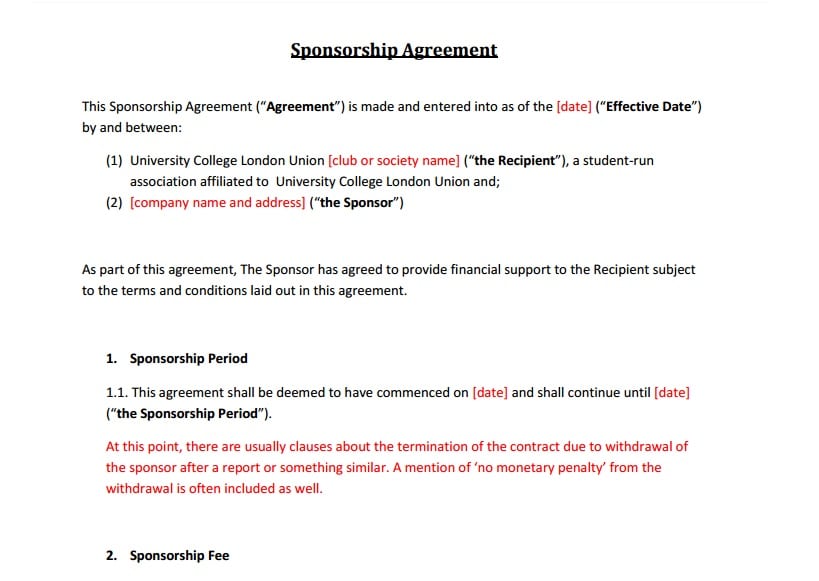

Sample Sponsor Agreement
Sponsorship Agreement in Word Format
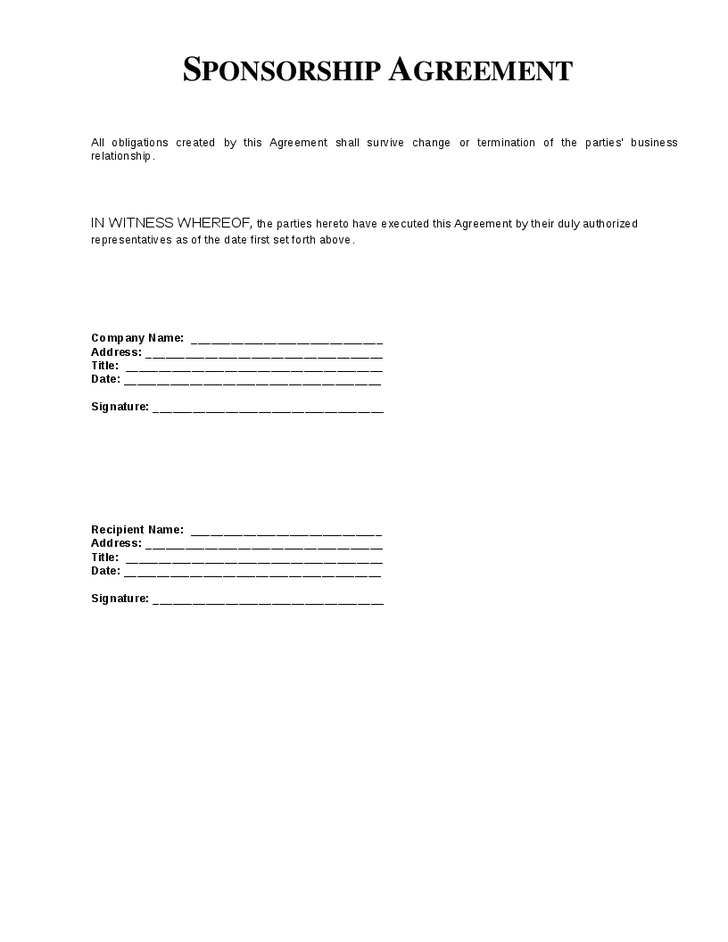
Community Sponsorship Agreement Example
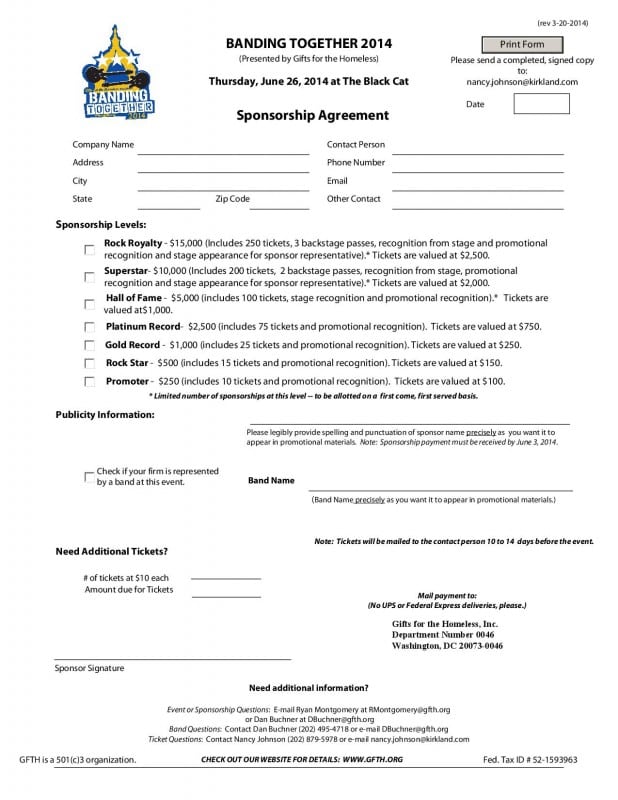
Editable Sponsorship Agreement Template


Sponsorship Agreement FAQs
What is the main purpose of a sponsorship agreement?
It records what the sponsor contributes, what benefits the sponsored party provides, and how both sides will manage approvals, risk, changes, and the end of the relationship.
Is sponsorship the same as a donation?
Not necessarily. Sponsorship commonly involves commercial benefits in return, while a donation may be made without equivalent promotion. Tax and charitable treatment depend on local rules.
Can products or services count as sponsorship?
Yes. Describe in-kind support with the same care as cash, including specifications, quantity, delivery, valuation, responsibility, and acceptance.
Should audience numbers be guaranteed?
Only when a party can genuinely make that commitment. Otherwise identify figures as historical data or projections and explain how actual results will be reported.
How specific should sponsor benefits be?
Very specific. State the channel, position, size, quantity, timing, duration, responsible person, and evidence for each promised benefit.
What is category exclusivity?
It limits competing sponsors within a defined product or service category. The category, period, territory, channels, and exceptions should be written clearly.
Can organizers share attendee email addresses with sponsors?
Only when applicable privacy law, notices, permissions, and contracts allow it. Voluntary sponsor lead capture may be more appropriate than transferring a full attendee list.
What happens if an event is postponed?
The agreement should cover notice, the replacement date or format, substitute benefits, completed obligations, costs, credits, refunds, and termination rights.
Who owns campaign photographs and videos?
Ownership depends on the agreement and applicable law. Address creation, model or performer permissions, sponsor reuse, territory, channels, and duration.
Can this template be signed without legal review?
A template can organize the discussion, but it cannot assess a specific deal. Independent local legal review is advisable before signing.