
A food flyer gets only a moment to work. Someone sees a photograph, notices a tempting offer, checks the location, and decides whether to order, visit, or keep scrolling. That is a lot of responsibility for one small page. The good news is that you do not need to begin with an empty document. This free food flyer template gives you a ready-made starting point that can be shaped around a restaurant, café, bakery, catering service, food truck, takeaway, or special menu promotion.
The template is editable, so the sample wording is not meant to stay. Replace it with your own dish, price, brand colors, contact details, and call to action. A focused flyer with one clear message will usually serve you better than a crowded design trying to advertise everything at once.
Before You Edit Anything, Decide What the Flyer Must Achieve
“Promote the business” sounds like a goal, but it is too broad to guide a useful design. Give the flyer one primary job. It might introduce a new restaurant, bring lunchtime traffic through the door, announce a weekend buffet, sell advance catering packages, or generate online orders with a discount code.
Finish this sentence before writing the headline:
After seeing this flyer, I want the reader to __________.
The answer could be “scan the ordering code,” “visit before 3 p.m.,” “book catering,” or “try the family meal.” Once that action is clear, every element can support it. Anything that distracts from the goal can be reduced or removed.
Food Flyer Ideas for Different Businesses
The same basic template can support many kinds of food marketing, but the message should match the business and the customer’s immediate need.
Restaurant Grand Opening
Lead with the opening date, cuisine, location, and a reason to visit now. A limited opening offer, complimentary item, live event, or reservation prompt can add urgency. New customers also need practical information: opening hours, address, parking guidance, and whether reservations are required.
Takeaway and Delivery Promotion
Make ordering effortless. Feature a small selection of popular meals, state the delivery area or collection option, and provide one obvious telephone number, website, or QR code. If minimum orders, delivery fees, or time restrictions apply, show them clearly rather than surprising the customer later.
Food Truck Flyer
Location and timing matter as much as the menu. Add the weekly schedule, recognizable landmarks, social account, and a short list of signature dishes. Because food trucks may move, encourage readers to follow the business for live location updates.
Catering Service Advertisement
Sell the outcome rather than displaying a long menu. Mention the event types served, approximate capacity, cuisine options, dietary accommodations, delivery or staffing services, and how to request a quote. Strong catering photography should suggest a complete event experience.
Bakery or Dessert Offer
Use a close, high-quality image and keep the copy warm and simple. Promote seasonal boxes, celebration cakes, preorder deadlines, flavor collections, or gift packages. Custom orders need a lead time, so make the ordering deadline easy to see.
Healthy Food Campaign
Focus on ingredients, convenience, portion options, or meal-plan benefits without making unsupported health claims. Accurate wording builds trust. If nutrition or allergen information matters, direct customers to a full menu or staff member rather than forcing every detail into the flyer.
The Five-Part Formula Behind an Effective Food Flyer
A persuasive restaurant flyer does not require dozens of components. It needs five things arranged in a sensible order.
1. An Appetite-First Image
The photograph is often the first thing people process. Use a real, well-lit image of the featured dish whenever possible. Natural texture, steam, fresh garnish, and a clean background can make food look inviting. Avoid stretching a small image or applying so many filters that the meal no longer resembles what customers receive.
2. A Headline With a Specific Promise
“Delicious Food Available” says very little. A stronger headline tells the reader what is special:
- Fresh Lunch Bowls Ready in 10 Minutes
- Friday Family Pizza Deal
- Handmade Desserts for Your Celebration
- Office Catering Without the Last-Minute Stress
- Grand Opening: Taste Our Signature Grill Menu
Keep the headline short enough to read from a distance. The business name can support the headline, but it does not always need to be the largest text on the page.
3. One Featured Offer
A flyer becomes confusing when five promotions compete for attention. Choose one lead offer and, if necessary, add two or three supporting items in smaller text. State what the customer receives, the price or discount, and the conditions that matter.
For example, “20% off” is incomplete if it applies only to collection orders on Tuesdays. Clear terms may take one extra line, but they protect customer trust.
4. Essential Business Details
A hungry reader should not have to search for the address, order number, or opening time. Include the information relevant to the offer:
- Restaurant or food business name
- Street address or service area
- Telephone or messaging number
- Website or online ordering link
- Opening hours
- Promotion dates
- Social media handle
- Reservation instructions
- Delivery or collection information
5. A Direct Call to Action
End with a simple instruction: Order online, Reserve your table, Call for a catering quote, or Visit us this weekend. The call to action should be visible and connected to the easiest response method.
Writing Food Flyer Copy That Sounds Tempting, Not Exaggerated
Good food copy is concrete. Instead of piling on adjectives such as “amazing,” “unbelievable,” and “best ever,” describe what makes the item appealing. Mention the cooking method, fresh ingredients, texture, serving style, or flavor contrast.
Compare these two lines:
Generic: Try our amazing and delicious chicken today!
More vivid: Chargrilled chicken, crisp salad, garlic sauce, and warm flatbread—made fresh for lunch.
The second version helps a reader picture the meal. It also sounds more believable.
Keep claims accurate. Do not describe a product as organic, allergen-free, sugar-free, locally sourced, halal, kosher, vegan, or gluten-free unless the business can support the claim and follow the necessary handling standards. When cross-contact is possible, use careful language and provide a way for customers to ask questions.
A Sample Flyer Message You Can Adapt
Here is a compact example for a neighborhood restaurant:
Make Friday Night Easy
Choose two large pizzas, garlic bread, and a family salad for $39. Freshly prepared for collection from 4 p.m.
Offer available Fridays this month while supplies last.
Order now: 555-0148
Find us: 24 Market Street
Online: yourrestaurant.example
The message answers the customer’s main questions without turning the flyer into a full menu. Replace the example values with truthful details for your promotion.
Design Choices That Make the Flyer Easier to Read
Food marketing can be colorful, but readability still comes first. Choose two main typefaces at most: one with personality for the headline and one simple face for prices, dates, and details. Use strong contrast between the text and its background.
Create a visual path. The reader should naturally move from the headline to the food image, then to the offer, and finally to the ordering information. White space is not wasted space; it helps important details stand apart.
Prices should be prominent but not disconnected from the product. Keep currency symbols, decimal formatting, and portion descriptions consistent. If an offer expires, make the date readable rather than hiding it in tiny text.
Brand colors are useful, but the food should remain the visual hero. Red, orange, yellow, green, black, and earthy neutrals are common in food design, yet there is no universal “restaurant color.” Choose a palette that fits the dining experience and remains legible in print.
How to Customize This Food Flyer Template
- Download the template and save a separate working copy.
- Replace the sample business name and headline.
- Insert a high-resolution photograph of the actual featured food.
- Rewrite the offer using concise, accurate wording.
- Add the correct price and promotion dates.
- Enter the address, order number, website, and opening hours.
- Add a clear call to action.
- Adjust colors and fonts to match the business.
- Check spelling, prices, dates, and telephone numbers.
- Print a proof at actual size before producing multiple copies.
If the design will also be shared online, export a clean image or PDF and test it on a phone. Small body text that looks fine on a desktop may be unreadable in a social feed.
Printing and Distribution: Make Every Copy Count
Choose the paper according to where the flyer will be used. Standard paper is economical for high-volume handouts, while a heavier matte or gloss stock can feel more polished on counters and noticeboards. Ask the printer about bleed and safe margins if the design extends to the edge.
Distribution should match the likely customer. A lunch offer belongs near offices, campuses, workshops, and local shops. Catering material may work better at venues, community centers, wedding suppliers, coworking spaces, and business networking events. Always get permission before leaving flyers on private property or posting them publicly.
Add a trackable element if you want to measure response. A unique coupon code, QR link, or “mention this flyer” message can reveal whether the campaign produces orders. Tracking turns the next flyer into an informed decision rather than another guess.
Using the Same Design Online
A printed flyer can become the foundation for a social post, email graphic, website banner, or digital menu announcement. Resize the layout instead of simply shrinking it. Mobile viewers need larger text and fewer details.
For social media, place the key offer and date directly in the graphic, then use the caption for conditions, menu options, and ordering instructions. Include alternative text when the platform supports it so people using screen readers can understand the promotion.
Food Flyer Mistakes Worth Catching Before Printing
- Too many dishes: A flyer is not a replacement for the full menu.
- No deadline: Customers cannot judge the urgency of a limited offer.
- Weak image quality: Blurry or dark food photographs reduce confidence.
- Tiny contact details: The response method should be easy to find.
- Missing conditions: State important restrictions clearly.
- Inconsistent branding: Use the same business name, colors, and tone customers see elsewhere.
- Unverified information: Call the printed number and test the QR code before distribution.
- Overloaded design: Remove decorative elements that compete with the offer.
Download the Free Food Flyer Template
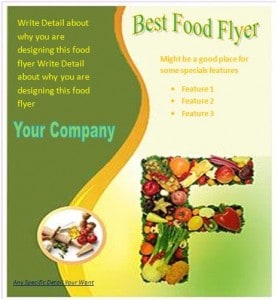
Use this editable template as the starting point for your own restaurant, catering, takeaway, or food-event promotion. The preview below shows the layout. Customize the text and imagery, review every business detail, and retain a clean master copy for the next campaign.

Food Flyer FAQs
What should I put on a food flyer?
Include a focused headline, appealing food image, specific offer, accurate price, promotion dates, business name, location, contact or ordering method, and a clear call to action.
How much information is too much?
If a reader cannot understand the main offer in a few seconds, the design is probably carrying too much. Move the full menu and detailed conditions to a website or QR-linked page.
Can I edit this flyer for a bakery or food truck?
Yes. Replace the restaurant wording, image, offer, and contact details. Food trucks should emphasize location and schedule; bakeries may need preorder deadlines and customization details.
What size should a restaurant flyer be?
Common choices include full-page, half-page, and postcard-sized layouts. The best size depends on how it will be displayed or distributed and how much essential information it must contain.
Should I add a QR code?
A QR code can make ordering, booking, or viewing a full menu easier. Test it on several phones and include a readable web address or telephone number as a backup.
Can I use a photograph found online?
Use your own photograph or an image you have permission and an appropriate license to use. A real photograph of the advertised dish also sets more accurate customer expectations.
How can I tell whether the flyer worked?
Use a unique coupon code, landing-page link, QR code, telephone extension, or customer question such as “How did you hear about us?” Compare the response with the cost of design, printing, and distribution.
Should prices appear on a food flyer?
Prices are helpful for a specific meal deal or promotion. If prices change frequently or the flyer promotes general catering services, invite the reader to request a current menu or quotation instead.
Can I share the finished flyer on social media?
Yes, but create a mobile-friendly version with larger text and fewer details. Put important conditions in the post caption and add alternative text for accessibility.
Is this food flyer template free?
Yes. You can download the template from this page and customize it with your own legitimate business details, photographs, promotion, and branding.