
Lending money can feel straightforward when everyone trusts one another. The difficulty usually arrives later, when memories differ: Was the payment due monthly or at the end? Was interest included? Could the borrower repay early? What happens if a payment is missed?
A written loan agreement turns those assumptions into terms both sides can review before money changes hands. The templates below provide starting points for personal, family, business, and other private lending arrangements. They must be adapted to the transaction and local law. A generic form is not a substitute for advice from a qualified lawyer, accountant, or regulated financial professional.
What a Loan Agreement Does
A loan agreement records the obligations between a lender and a borrower. It identifies the parties, states how much is being lent, explains when funds will be delivered, and describes how repayment will work.
A strong agreement also addresses events that may not occur: a late payment, early repayment, change of address, dispute, death, insolvency, sale of collateral, or modification of the schedule.
The document does not guarantee repayment. Its value lies in clarity, evidence, and a process the parties understand.
Loan Agreement, Promissory Note, and IOU
These terms are sometimes used interchangeably, but they can serve different functions.
An IOU is usually a brief acknowledgment that one person owes another. It may not contain a repayment schedule, interest terms, or enforcement provisions.
A promissory note is generally a signed promise by the borrower to repay a defined debt according to stated terms.
A loan agreement is often more detailed and signed by both parties. It can include representations, conditions before funding, collateral, reporting duties, default provisions, and dispute terms.
The legal meaning and enforceability of each document depend on jurisdiction and circumstances. Use the form appropriate to the transaction rather than choosing by title alone.
Identify the Parties Precisely
State the full legal name and address of the lender and borrower. For a company, confirm the exact registered entity and the authority of the person signing. A trading name may not identify the legal party responsible for the debt.
If there is more than one borrower, the agreement should explain whether each person is responsible for the entire obligation or only a stated share. This distinction can have major consequences and should be reviewed professionally.
When a guarantor is involved, the guarantee requires careful, jurisdiction-specific drafting. Do not add someone’s name casually or assume a witness signature creates a valid guarantee.
State the Principal and Funding Method
The principal is the amount borrowed before interest and charges. Write the amount and currency clearly. Explain whether the lender will:
- Transfer funds to a bank account
- Pay a supplier on the borrower’s behalf
- Advance the money in stages
- Deliver funds after conditions are met
- Convert an existing amount owed into a formal loan
Record the funding date or method for determining it. Keep independent evidence of the transfer. A signed agreement stating that money was lent may not resolve a later dispute if the funding record is unclear.
Interest: More Than a Percentage
If interest applies, the agreement should explain:
- The annual or periodic rate
- Whether the rate is fixed or variable
- How interest is calculated
- When interest begins
- How often it accrues or compounds
- Whether unpaid interest is added to principal
- Any default or late rate
- The effect of early payment
Interest, fee, disclosure, and consumer-credit laws vary widely. Some private loans can fall within regulated lending rules, and some rates or charges may be limited or unenforceable. Obtain local legal advice before using interest language from a general template.
Build a Repayment Schedule People Can Follow
A repayment clause should answer practical questions without forcing the parties to perform new calculations each month.
Specify:
- First payment date
- Payment amount
- Frequency
- Number of payments
- Final maturity date
- Payment destination
- Accepted payment methods
- How payments are applied
- What happens when a due date is not a business day
- Whether a final balloon payment exists
Attach a schedule for installment loans. Check that the payment totals match the principal, interest method, fees, and final balance. Spreadsheet calculations should be independently reviewed.
A Simple Example Structure
Consider a hypothetical $12,000 loan repaid in twelve monthly principal installments, with interest calculated separately according to the agreement. The schedule might identify:
- Funding date: October 1, 2026
- First payment date: November 1, 2026
- Monthly principal: $1,000
- Final maturity: October 1, 2027
- Payment method: Bank transfer
This example is not a recommendation or calculation for a real loan. The interest method, legal disclosures, taxes, and payment amount must be determined for the actual transaction.
Secured and Unsecured Loans
An unsecured loan relies on the borrower’s promise and available legal remedies without specifically pledged property.
A secured loan identifies collateral that may support repayment. Collateral can involve vehicles, equipment, inventory, accounts, real estate, or other assets, but creating and enforcing a valid security interest often requires additional agreements, notices, registrations, filings, or possession.
Do not assume that mentioning an asset in a loan agreement makes the security valid. Ownership, existing liens, priority, description, filing, and enforcement rules require jurisdiction-specific review.
Purpose of the Loan
Some agreements allow funds to be used for any lawful purpose. Others limit use to a home improvement, education cost, equipment purchase, working capital, vehicle, or specific project.
If purpose matters to the lender, write a realistic monitoring and remedy process. A vague purpose statement with no operational effect can create conflict without protecting either side.
Conditions Before Funding
A business or secured loan may require documents before money is released, such as:
- Signed agreement
- Identity or entity verification
- Board or member authorization
- Insurance evidence
- Security documents
- Valuation or ownership evidence
- Guarantor documentation
- Bank details
List the conditions clearly and avoid collecting more personal data than necessary. Sensitive documents should be stored securely.
Late Payments and Default
Default provisions should not be copied casually from a commercial form. They may define serious consequences, including acceleration of the full balance or enforcement against collateral.
Common events include:
- Failure to pay after any applicable grace period
- False material statements
- Breach of another obligation
- Unauthorized disposal of collateral
- Insolvency or bankruptcy-related events
- Failure to maintain required insurance
The agreement should describe notice, any opportunity to cure, lawful fees, acceleration, and available remedies. Consumer-protection, bankruptcy, debt-collection, and secured-transactions laws can restrict these terms.
Early Repayment
State whether the borrower may pay early, whether partial prepayments are allowed, how they affect future installments, and whether any lawful charge applies.
Prepayment penalties may be restricted or prohibited in certain loans. If no penalty applies, say so. If the agreement is silent, the parties may later disagree about interest that would otherwise have accrued.
Late Fees and Collection Costs
Any late charge should be clear, reasonable, and permitted. The document should say when it applies and whether it is a fixed amount or calculated figure.
Clauses requiring the borrower to pay legal or collection costs may be limited by law and court rules. Do not assume every expense can be shifted merely because a template says so.
Notices and Communication
Identify the permitted methods for formal notices and the addresses or email contacts to use. Explain when notice is considered received and how a party updates contact information.
Routine payment reminders and formal default notices are not necessarily the same. Preserve evidence of important communications.
Amendments
Real loans sometimes change. The parties may extend a due date, revise the installment amount, release collateral, or change payment details.
Require amendments to be documented and signed by the appropriate parties. Avoid relying on informal messages for major changes. The amendment should identify the original agreement and state exactly what remains unchanged.
Governing Law and Disputes
Loan agreements commonly select governing law and a dispute forum. Arbitration, mediation, court jurisdiction, legal fees, and waiver provisions can materially affect rights.
These clauses deserve legal advice. A lender cannot necessarily choose any law or forum, especially where consumer or property rules apply.
Signatures, Witnesses, and Notarization
Include dated signature blocks for every required party and identify the capacity of company signers. Electronic signatures may be valid, but requirements differ by document, transaction, and jurisdiction.
A witness or notary does not automatically make unfair or illegal terms enforceable. Conversely, some documents or security interests may require particular formalities. Confirm what applies before signing or funding.
Family and Friend Loans
Personal trust makes written terms more important, not less. A document can protect the relationship by separating generosity from uncertainty.
Discuss uncomfortable questions before lending:
- Is this truly a loan rather than a gift?
- Can the borrower realistically repay?
- What happens if employment or health circumstances change?
- Will interest apply?
- How will late payments be discussed?
- Will other family members misunderstand the arrangement?
- What happens if either party dies?
Tax consequences can arise from below-market or forgiven loans. Obtain professional advice rather than relying on informal assumptions.
Business Loans
Business lending may involve financial statements, covenants, borrowing authority, guarantees, collateral, reporting, and restrictions on additional debt. Confirm whether the borrower is the company, an owner personally, or both.
Company representatives should approve the transaction according to governing documents and law. Mixing personal and business funds without clear records can create accounting and legal problems.
Before Signing: A Review Checklist
- Correct legal names and addresses
- Correct principal and currency
- Clear funding process
- Lawful and understandable interest terms
- Accurate payment schedule
- Defined maturity date
- Early-payment treatment
- Late-payment and default process
- Accurate collateral description, if any
- Notice details
- Amendment process
- Governing law and dispute terms
- Required signatures and approvals
- Independent legal and tax review where appropriate
Each party should receive a complete signed copy. Funding evidence, repayment records, notices, amendments, and security documents should be retained securely.
Download the Loan Agreement Templates
The following templates and examples are starting points, not ready-to-sign legal advice. External resources may change or apply to different jurisdictions. Review the entire document, remove irrelevant clauses, add transaction-specific terms, and obtain qualified advice before lending or borrowing.
Editable Loan Agreement Template


Printable Loan Agreement Template


Loan Agreement Draft

Blank Loan Agreement Template
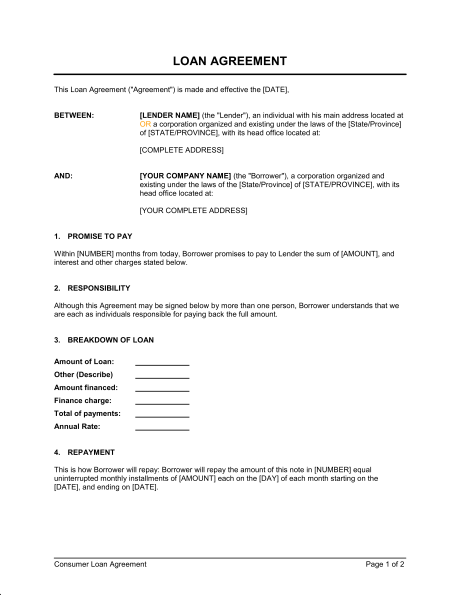
Sample Loan Agreement

Printable Loan Agreement

Loan Agreement FAQs
Can I write my own loan agreement?
You can prepare a draft, but enforceability and required terms depend on the transaction and jurisdiction. Professional legal review is advisable, especially for interest, collateral, guarantees, consumer lending, or large amounts.
Does a loan agreement need interest?
Not always, but interest-free or below-market loans can have legal or tax consequences. State the intended treatment clearly and obtain advice.
Is a witness or notary required?
Requirements vary. Some transactions or security documents need particular formalities, while others do not. Confirm local requirements before signing.
What is collateral?
Collateral is property intended to secure repayment. Creating an enforceable security interest may require precise description, additional documents, and official filing or registration.
Can a borrower repay early?
The agreement should say whether full or partial prepayment is allowed and how interest, fees, and future installments are affected.
What happens after a missed payment?
Follow the agreement and applicable law regarding notice, grace periods, cure, fees, acceleration, collection, and enforcement. Do not use unlawful collection methods.
Can the parties change the agreement later?
Yes, if they document the amendment properly and obtain all required signatures or approvals. Keep it with the original agreement.
Is a family loan taxable?
It can have tax implications involving interest, gifts, forgiveness, or reporting. Consult a qualified tax professional for the specific arrangement.
Do these templates work in every country?
No. Laws and required disclosures vary. Treat them as drafting references and obtain advice for the governing jurisdiction.
Are these loan agreement templates free?
The templates and linked examples are offered as reference resources, but external sites may have their own terms or charges. Review each source before use.