
A certificate of origin states where goods originate under an applicable rule of origin. It is not simply the country where a shipment was packed, stored, sold, or dispatched. The answer can affect tariff treatment, customs clearance, trade statistics, sanctions controls, quotas, and eligibility under a trade agreement.
These six free certificate of origin templates provide visual and editable starting points. Use them only after confirming which form, issuing process, origin rule, certification wording, and supporting evidence the destination, trade agreement, buyer, bank, or customs authority requires. A generic template cannot determine origin.
Preferential and Non-Preferential Origin
Preferential origin may qualify goods for reduced or zero duty under a trade agreement or preference program. The goods must satisfy that program’s specific origin rules and procedural requirements.
Non-preferential origin is used for measures outside a tariff preference, such as trade statistics, labeling, quotas, trade remedies, or other policy controls. Its rules may differ from preferential rules. The same product can require different analysis depending on the purpose and destination.
Never assume a “made in” label, supplier address, invoice country, or shipping point proves origin for customs purposes.
Who May Issue or Certify the Document?
The required issuer depends on the route and legal framework. It may be the exporter, producer, importer, authorized body, chamber of commerce, customs authority, or another designated organization. Some systems use self-certification; others require validation, stamps, electronic registration, or prescribed forms.
Confirm current official requirements before preparing the document. If a chamber or authority must certify it, use its accepted portal, format, evidence, and signing process rather than recreating the form independently.
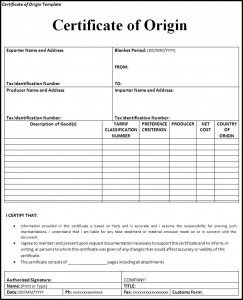
Common Certificate Fields
- Exporter or consignor name, address, and registration details
- Producer details when required and permitted
- Consignee or importer
- Transport, route, and shipment references
- Invoice number and date
- Package marks, numbers, types, and counts
- Accurate goods description
- Quantity, weight, or other required measure
- Tariff classification where required
- Country of origin
- Origin criterion or rule where required
- Declaration, place, date, name, signature, and capacity
- Certifying-body endorsement when applicable
Use the official instructions for the specific certificate. Adding plausible fields does not make a document compliant, and omitting a prescribed statement can invalidate a preference claim.
Describe the Goods Accurately
Descriptions should let customs and the commercial parties identify the goods. “Parts,” “samples,” “equipment,” or “merchandise” may be too vague. Include the commercial name, model or article number, material, function, and other details required to link the certificate to the invoice and shipment.
Keep descriptions consistent across the certificate, invoice, packing list, transport documents, licenses, and declarations. If wording differs for a legitimate reason, retain evidence explaining the relationship.
Tariff Classification and Origin Are Different
Tariff classification identifies goods under a nomenclature. Origin applies a legal rule to the production history. Classification may be part of the origin analysis-especially where a rule depends on a tariff shift-but one does not automatically determine the other.
Classification and origin can be complex and high stakes. Obtain qualified customs or trade advice and consider binding rulings or official determinations where available and appropriate.
How Origin May Be Determined
Common concepts include wholly obtained goods and sufficiently worked or processed goods. Product-specific rules may use a change in tariff classification, regional value content, specified manufacturing operation, weight or value threshold, or a combination.
Minimal operations-such as simple packaging, sorting, labeling, or minor assembly-may not confer origin. The exact rule, definitions, tolerances, cumulation provisions, and calculation method come from the applicable legal framework.
Supplier Declarations and Production Evidence
An exporter may need bills of materials, supplier declarations, production records, cost data, tariff classifications, manufacturing flow, purchase records, and evidence of where materials were obtained or processed.
Check supplier statements for product coverage, period, signature, origin basis, and consistency. A supplier’s unsupported country claim should not be copied automatically. Keep evidence connected to the exact goods and shipment or approved long-term period.
Invoice and Shipment Reconciliation
Compare exporter, importer, invoice, package marks, quantities, weights, descriptions, and transport references across the document set. Resolve differences before submission. The certificate should not cover more goods than the supporting evidence justifies.
For split shipments, mixed-origin goods, sets, kits, accessories, spare parts, or fungible materials, apply the relevant rules and inventory method carefully. A template cannot decide whether items may be grouped under one origin statement.
Preferential Claims Require More Than a Form
A signed certificate does not make goods eligible. Eligibility comes from satisfying the origin rule and every applicable procedural condition. Confirm direct transport or non-alteration requirements, approved-exporter status, statement wording, value thresholds, validity periods, and presentation rules.
Do not claim preferential origin merely because the buyer requests it or because goods were purchased in a partner country. Incorrect claims can lead to denied preference, back duties, penalties, delays, and commercial disputes.
Electronic Certificates and Signatures
Some authorities accept electronic certificates, digital signatures, portal records, or data elements instead of paper originals. Others require particular signatures, seals, or originals. Verify acceptance for the exact route and date.
Protect signing credentials, restrict who may certify origin, and retain submission receipts and final copies. Do not paste an image of a signature or official seal into an unofficial file without authority.
Corrections, Replacements, and Retrospective Certificates
Do not erase or overwrite a certified document informally. Follow the issuer’s procedure for corrections, cancellations, replacements, duplicates, or retrospective issue. Preserve the original number, reason, approval, and link to the replacement where required.
A buyer’s request to change origin, description, invoice, or quantity after shipment should trigger review of the evidence and declaration-not a quick edit. A corrected certificate must remain truthful and consistent with the applicable process.
Record Retention and Verification
Keep the final certificate, application, invoice, packing list, transport records, origin calculations, bills of materials, supplier declarations, production evidence, correspondence, and issuing-body receipt for the required period. Retention rules differ by agreement, jurisdiction, role, and claim.
Organize evidence so it can be retrieved by certificate, invoice, product, supplier, and period. Restrict commercially sensitive cost and sourcing data, but ensure authorized reviewers can reconstruct the basis of the claim.
Common Certificate of Origin Errors
- Using the dispatch country as the origin without analysis
- Selecting the wrong preferential or non-preferential form
- Using vague or inconsistent goods descriptions
- Incorrect tariff classification or origin criterion
- Claiming more quantity than the evidence covers
- Copying an expired supplier declaration
- Missing signature, date, capacity, stamp, or prescribed wording
- Conflicting invoice, package, weight, or consignee information
- Assuming simple packaging or labeling changes origin
- Keeping the certificate without the supporting origin file
Internal Review Workflow
- Identify the destination, purpose, and applicable origin framework.
- Confirm the product and tariff classification.
- Obtain the product-specific origin rule and definitions.
- Collect production and supplier evidence.
- Perform and document the origin analysis.
- Reconcile the certificate with invoice and shipment data.
- Obtain authorized review and signature.
- Submit through the required issuer or portal.
- Retain the final certificate and complete support file.
Use independent review for new products, new trade routes, complex bills of materials, material supplier changes, and high-value or high-risk claims.
How to Customize a Template Safely
Begin with the prescribed form if one exists. If a free-form certificate is accepted, add only the data and declaration required for the transaction. Use the exporter’s correct legal details, a unique reference, clear goods lines, package marks, quantities, origin country, authorized signature block, and issuer section where applicable.
Keep an untouched master and restrict edits to trained personnel. Use controlled lists for country names and units, protect fixed declaration wording, and validate required fields. A polished document is not compliant if the origin basis is unsupported.
Example Review Scenario
An exporter in Country A ships assembled appliances to Country B under a trade agreement. Some components come from Countries A, B, and C. The exporter cannot declare Country A merely because final assembly occurred there. It must identify the product-specific rule, confirm classification, evaluate materials and processing, apply any allowed cumulation or tolerances, calculate value content if required, and retain supporting records.
If the rule is satisfied and the procedural requirements are met, the authorized party completes the accepted proof of origin. If it is not satisfied, the shipment may still proceed, but preferential treatment should not be claimed on an unsupported basis.
Legal and Compliance Caution
Origin errors can affect duty, penalties, audits, sanctions, licensing, customer contracts, and supply-chain representations. Rules change and may differ between authorities. This page provides general administrative guidance, not customs, legal, tax, sanctions, or trade-compliance advice.
Use current official sources and qualified professionals. For uncertainty, consider requesting an advance or binding origin decision where the relevant authority provides one.
Final Check Before Submission
Confirm the exact form, issuer, declaration text, origin rule, evidence, invoice, package data, quantities, weights, dates, signatures, and validity. Check that every covered product is supported and that no draft watermark, placeholder, or sample information remains.
The most important part of a certificate of origin is not the design. It is the documented, defensible connection between the goods, the applicable rule, and the country claimed.
Preview and Download the Certificate of Origin Templates
The six original previews are preserved below. The external examples display their original download buttons without active destination links; the final Word document remains available directly from this site.
Certificate of Origin Form
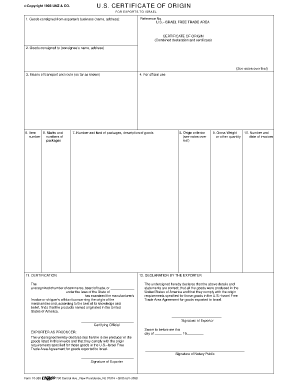

Blank Certificate of Origin
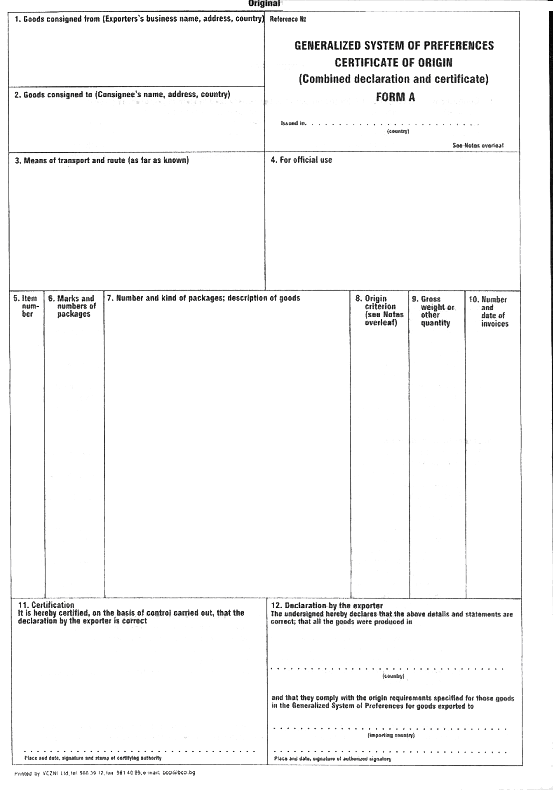
Certificate of Origin Sample
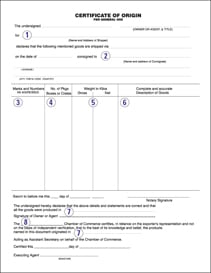
Printable Origin Certificate
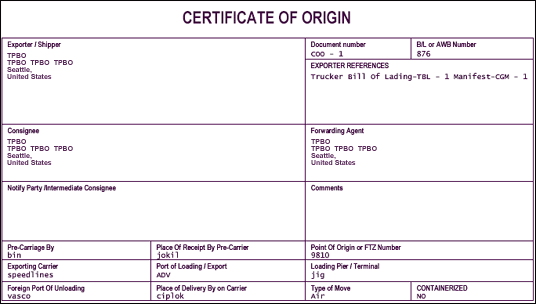
Trade Certificate of Origin Example
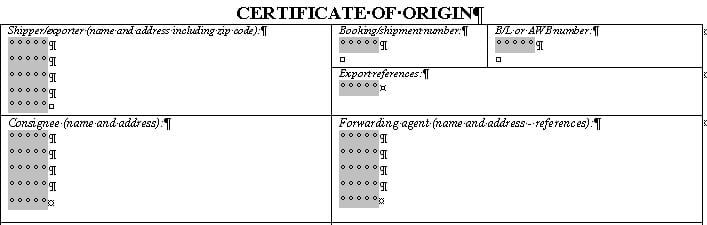
Editable Certificate of Origin Template

Certificate of Origin Template FAQs
What does a certificate of origin prove?
It declares the origin of covered goods under an applicable origin framework and supported evidence.
Is origin the country of export?
Not necessarily. Dispatch, sale, packaging, and origin are different concepts.
Who may sign or certify the certificate?
That depends on the route and rules; it may be an exporter, producer, importer, chamber, customs authority, or other authorized body.
Does the certificate create preferential eligibility?
No. Goods must satisfy the applicable origin rule and procedural requirements.
What evidence should be retained?
Keep the certificate, invoice, shipment records, origin calculation, production evidence, supplier declarations, and submission receipt as required.
Can an error be edited after certification?
Use the issuer’s formal correction, cancellation, duplicate, or replacement process and preserve the audit trail.
Can I edit the hosted Word template?
Yes, if a free-form document is accepted. Use the prescribed official form whenever one is required.
Does this template replace customs advice?
No. Obtain current official guidance and qualified trade-compliance advice for the specific goods and route.