
Risk management is not a prediction contest. The team does not need to imagine every possible disaster; it needs a repeatable way to notice uncertainty, judge what matters, choose a response, and recognize when conditions have changed.
This free risk management plan template for Microsoft Word gives projects and small organizations a practical framework for doing that work. It can support business initiatives, software implementations, events, construction planning, operations, product launches, nonprofit programs, procurement, and internal change. Adapt the depth to the consequences involved: a small office project needs less formality than safety-critical, regulated, medical, financial, or public infrastructure work.
Start With Objectives, Not a List of Fears
A risk is uncertainty that can affect an objective. If the objective is unclear, the risk register quickly becomes a collection of vague worries.
Write down:
- What the project or activity is expected to achieve
- What must be delivered, and by when
- Budget, quality, scope, safety, compliance, and performance constraints
- Who may be affected
- Important assumptions and dependencies
- Conditions that would count as success or failure
“The vendor might be late” becomes meaningful when the plan shows that vendor equipment must arrive by June 3 to complete testing before a fixed public launch.
Define the Risk Management Approach
The plan should explain how the team will manage risks, not merely hold a table of entries. Define the roles, scoring method, review schedule, reporting route, escalation thresholds, record location, and approval authority.
For a modest project, the process may be a 20-minute review during the weekly project meeting. A complex program may require specialist assessments, quantitative analysis, formal committees, audits, independent assurance, and regulated reporting. Use a process proportionate to both likelihood and consequence.
Who Owns What?
Every significant risk needs an owner: one person accountable for monitoring the risk and ensuring the agreed response is carried out. The owner does not have to perform every action personally.
Also identify action owners. For example:
- Risk owner: Operations manager
- Action owner: Procurement lead
- Action: Confirm backup supplier capacity by April 15
A risk assigned to “the team” is often assigned to nobody. Use named roles or people, depending on the document’s purpose and privacy needs.
Find Risks From More Than One Angle
A useful risk-identification session examines the project from several perspectives:
- Schedule: approvals, dependencies, lead times, resource conflicts
- Cost: price changes, estimation error, exchange rates, rework
- Scope and quality: unclear requirements, defects, acceptance criteria
- People: capacity, turnover, skills, fatigue, communication
- Suppliers: availability, solvency, concentration, contract performance
- Technology: integration, security, performance, data loss, obsolescence
- Legal and compliance: permits, privacy, licensing, accessibility, reporting
- Health and safety: hazards, exposure, emergency response, competence
- Stakeholders: opposition, expectations, adoption, reputation
- External conditions: weather, utilities, transport, policy changes, disruption
Review assumptions as potential risks. “The customer will provide clean data by Monday” is an assumption; late or unusable data may threaten the schedule and quality.
Write a Risk Statement That Can Be Managed
A clear risk statement connects cause, uncertain event, and impact:
Because the imported equipment has a ten-week lead time, customs clearance may take longer than planned, causing installation and user testing to miss the launch window.
A label such as “supplier risk” is too broad. A statement such as “the project will fail” is too absolute. Good wording makes causes and consequences visible, which helps the team choose targeted controls.
Probability and Impact Scoring
Many teams use a simple scale from 1 to 5 for likelihood and impact. Define each level so different reviewers apply it consistently.
A probability scale might mean:
- 1 — Rare
- 2 — Unlikely
- 3 — Possible
- 4 — Likely
- 5 — Almost certain
Impact can be rated separately for cost, schedule, quality, safety, reputation, compliance, or service. The overall rating might use the highest relevant consequence or another method approved by the organization.
Some teams calculate likelihood × impact to prioritize review. That score is a screening tool, not objective truth. Two risks with a score of 12 may be fundamentally different, especially when one involves human safety or a legal breach. Define mandatory escalation rules for consequences that cannot be reduced to a generic number.
Inherent Risk and Residual Risk
Inherent risk is the exposure before considering controls. Residual risk is what remains after existing and planned controls.
Suppose unauthorized access to customer data has high inherent impact. Controls such as least-privilege access, multifactor authentication, encryption, logging, training, and incident response may reduce likelihood or limit consequences, but they do not make the risk vanish. The residual rating should reflect credible control performance, not optimism.
Record evidence that a control exists and works. “Staff are careful” is not a reliable control description.
Choose a Response Strategy
Avoid
Change the plan so the threat no longer exists. A team might remove an unnecessary collection of sensitive data or select a proven technical approach instead of an unstable dependency.
Reduce or Mitigate
Lower probability, impact, or both. Examples include testing earlier, adding review gates, training staff, creating backups, diversifying suppliers, or improving physical safeguards.
Transfer or Share
Allocate part of the financial or operational consequence through insurance, contracts, partnerships, or specialist providers. Transfer does not remove accountability, reputational exposure, or every legal duty.
Accept
Take no additional preventive action beyond monitoring because the exposure is within approved tolerance or treatment would cost more than the likely benefit. Acceptance should be informed, authorized, documented, and paired with a contingency when necessary.
Opportunities—uncertain events with beneficial effects—can also be managed by exploiting, enhancing, sharing, or accepting them. Keep threat and opportunity language clear so reports are not confusing.
Controls, Actions, Contingencies, and Fallbacks
These terms are related but not identical.
- Existing control: something already operating, such as automated backups.
- Mitigation action: planned work to reduce exposure, such as testing restoration monthly.
- Contingency plan: what the team will do if the risk occurs, such as switching to a recovery environment.
- Fallback: what happens if the contingency is insufficient, such as temporarily providing a reduced manual service.
Actions should have an owner, due date, status, cost or resource need, and expected effect. “Monitor closely” is not enough unless the plan explains what will be monitored, by whom, how often, and what triggers action.
Use Triggers and Early-Warning Indicators
A trigger is observable evidence that exposure is increasing or the event has occurred. Examples include:
- A supplier misses a design-approval milestone
- Defect rates exceed an agreed threshold
- Budget variance reaches a defined percentage
- Key staff availability drops below the plan
- A permit remains unapproved by a specified date
- Security monitoring detects a defined pattern
Triggers turn the risk plan into an operating tool. Without them, teams often wait until a concern becomes a crisis.
Maintain a Risk Register
The register typically includes:
- Unique risk ID
- Category
- Cause-event-impact statement
- Date identified and source
- Existing controls
- Likelihood and impact
- Overall rating
- Response strategy
- Mitigation actions, owners, and dates
- Contingency and trigger
- Residual rating
- Status and last review date
Keep closed risks rather than deleting them. Record why and when they were closed. This preserves the project history and helps future teams learn.
Risk Appetite, Tolerance, and Escalation
Risk appetite describes the general amount and type of risk an organization is willing to pursue or retain. Tolerance defines more specific boundaries or variation around objectives. The project team should know which exposures it can accept and which require senior, legal, safety, privacy, security, or regulatory review.
Escalation criteria might include any risk that threatens life or safety, breaches a legal requirement, exceeds budget authority, affects a critical service, exposes sensitive data, or crosses a defined rating threshold.
Review Risks Throughout the Work
Risk identification is not a kickoff exercise that disappears into a folder. Review at meaningful points:
- Project initiation and planning
- Before a major procurement or commitment
- At phase gates and design approvals
- After scope, schedule, or supplier changes
- Following incidents, near misses, or audit findings
- Before launch, handover, or operational transition
- At regular intervals appropriate to the pace of change
At each review, confirm ratings, controls, action status, new information, ownership, and whether the response still makes sense.
Connect Risks to Decisions and Changes
When a change request is raised, assess how it affects existing risks and whether it creates new ones. When a key decision is made, record the risk information considered. When an issue occurs, connect it to the relevant risk or create an issue record if it was not anticipated.
A risk may happen. An issue has happened or is happening. Once the uncertain event occurs, manage the issue through an owner, action plan, priority, and resolution path while updating the risk record.
Common Weaknesses in Risk Plans
- Listing only catastrophic events and ignoring ordinary delivery risks
- Using vague labels instead of cause-event-impact statements
- Assigning every risk to the project manager
- Scoring without defined criteria
- Claiming controls are effective without evidence
- Confusing actions with contingencies
- Leaving due dates blank
- Reducing every residual score to “low”
- Failing to revisit risks after major changes
- Treating a colorful heat map as the analysis itself
Tailor the Template Responsibly
Download the Word document and keep a clean master. Add the project name, objectives, scope, roles, scoring definitions, escalation rules, review rhythm, and risk register. Delete fields that add no decision value, but retain enough detail for accountability.
For health and safety, cybersecurity, financial services, healthcare, engineering, environmental, legal, or other regulated contexts, a general template is not a substitute for required standards, specialist analysis, statutory duties, or professional judgment. Use qualified experts and the current rules applicable to the work.
Download Your Risk Management Plan Template
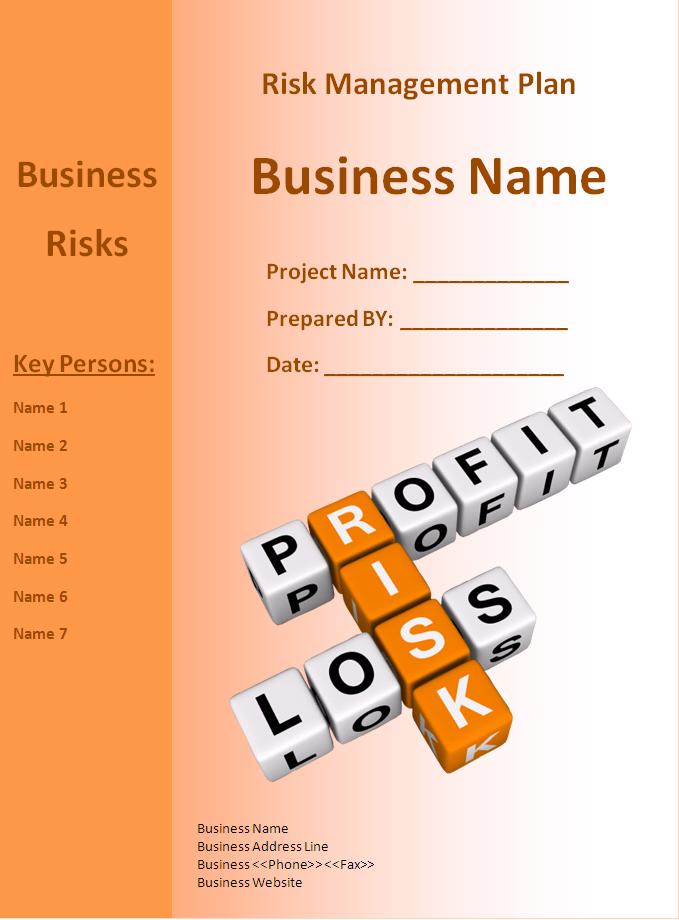
The preview below shows the editable plan layout. Download the Word file, adapt its scoring and governance to your organization, and review the register as conditions change.

Risk Management Plan FAQs
What is a risk management plan?
It explains how risks will be identified, analyzed, owned, treated, monitored, reported, escalated, and reviewed during a project or activity.
How is a risk plan different from a risk register?
The plan defines the process and governance. The register records individual risks, ratings, controls, responses, owners, actions, and status.
Who should own a project risk?
A person with sufficient knowledge and authority to monitor the exposure and ensure the response happens. Specific mitigation actions may be assigned to other people.
How often should risks be reviewed?
At a frequency that matches the pace and consequence of change, plus after major decisions, incidents, scope changes, phase gates, or new information.
What does residual risk mean?
It is the remaining exposure after existing and planned controls are considered. It should reflect credible control effectiveness.
Can a risk be accepted?
Yes, when the exposure is within authorized tolerance and acceptance is informed and documented. High-consequence risks may require specialist or senior approval.
What is a risk trigger?
A measurable sign that risk is increasing or has occurred, prompting monitoring, escalation, mitigation, or contingency action.
Should opportunities appear in the plan?
They can. Uncertainty may create beneficial effects as well as threats, but use clear labels and a consistent method.
Is this template suitable for regulated or safety-critical work?
It may be a starting point only. Such work often requires specific standards, statutory processes, specialist methods, and qualified professional review.
Is the risk management plan template free?
Yes. Download and customize the Word template for your legitimate project or organizational planning needs.