
A cash drawer can balance at the end of the day and still have weak records. If nobody can show who requested money, who approved it, what it purchased, and whether unused funds came back, the organization has an accountability gap.
This free cash request slip template provides a clear record before cash leaves the drawer. It can support petty cash purchases, travel advances, urgent supplies, delivery expenses, field activities, event costs, and other small authorized payments. Businesses, schools, nonprofits, clubs, and project teams can customize the editable file to match their own approval and accounting process.
The slip is one control, not the entire system. It should connect to a petty cash register, receipts, reconciliations, accounting records, approval limits, and secure cash handling.
What Is a Cash Request Slip?
A cash request slip is a form used to ask for money before an expense is paid. It explains the business purpose, amount, budget code, requester, and required date. It then records approval and, when cash is issued, the recipient and custodian acknowledgments.
Some organizations use the same document to settle an advance after the purchase. Others use separate request, voucher, and expense forms. Either approach can work if responsibilities and records are clear.
Related Documents Are Not Interchangeable
- Cash request: asks for funds before spending.
- Cash advance: gives funds to a custodian who must account for them later.
- Petty cash voucher: records a payment from a petty cash fund.
- Reimbursement request: asks the organization to repay an expense already paid personally.
- Receipt: provides evidence of the actual purchase or payment.
Use accurate labels. Otherwise, an advance can be mistaken for a completed expense or a person may be reimbursed for something already paid from petty cash.
Fields to Include
A useful request form normally contains:
- Unique request or voucher number
- Request date and date funds are needed
- Requester name, role, and department
- Amount and currency
- Detailed purpose
- Project, grant, client, or cost center
- Expense or general ledger code
- Budget availability confirmation
- Estimate, quotation, or other support
- Requester acknowledgment
- Approver name, decision, signature, and date
- Cash issue date and amount
- Issued-by and received-by details
- Settlement due date
- Actual expense and returned cash
- Receipt or attachment references
The exact fields depend on the organization, but the form should support authorization, custody, accounting, and reconciliation without relying on someone’s memory.
Use a Controlled Number
Assign every slip a unique identifier such as CR-2026-0048. A sequence makes missing, duplicated, or altered forms easier to identify. Keep voided numbers in the record instead of reusing them.
Organizations with several branches or funds may add a location or fund code. Make sure different employees cannot unknowingly issue the same number.
Describe the Purpose Properly
“Miscellaneous expense” or “office supplies” is rarely enough. The description should allow an approver and later reviewer to understand why cash is needed.
A better entry would be:
Purchase four replacement power adapters for the September 26 training session. Local supplier accepts cash only; written estimate attached.
Add quantity, event, location, supplier, or operational need when relevant. Do not include unnecessary personal or confidential information.
Approval Before Payment
The request should be approved before cash is issued, except where a documented emergency procedure applies. Approval means the reviewer has considered:
- Legitimate business purpose
- Budget and funding availability
- Policy eligibility
- Reasonableness of the amount
- Supporting evidence
- Requester’s open advances
- Whether another payment method is safer or more appropriate
The requester should not approve their own request. Higher amounts, unusual transactions, restricted funds, or regulated expenses may need additional approval.
Separation of Duties
Ideally, different people request, approve, issue, record, and reconcile cash. Small organizations may not have enough staff for complete separation. Compensating controls can include lower limits, owner or board review, numbered vouchers, independent bank reconciliation, surprise cash counts, and frequent reporting.
No single person should control the entire process without oversight.
When Cash Is Issued
Approval is not evidence that the recipient received money. At the issue stage, record:
- Date and time
- Amount issued
- Recipient name and acknowledgment
- Cashier or custodian name
- Fund or drawer
- Related request number
- Settlement deadline
Verify the approved amount and recipient authority. Never ask someone to sign for money they did not receive.
Settlement After the Expense
A cash advance remains outstanding until receipts are reviewed and unused cash is returned. The settlement should reconcile:
Cash issued = Approved expenses + Cash returned
Record the actual amount spent, receipt references, cash returned, settlement date, and reviewer. If the expense exceeds the advance, use the organization’s reimbursement and approval procedure rather than rewriting the original request.
Worked Example
A program coordinator requests $120 for local transport and workshop supplies. The project manager verifies the budget and Finance approves request CR-2026-0117. The petty cash custodian issues $120, and the coordinator signs for it.
After the workshop, receipts total $107.50. The coordinator returns $12.50. Finance confirms that $107.50 plus $12.50 equals the $120 issued, posts the expense to the project code, and closes the advance.
The record now shows authorization, custody, evidence, accounting, and closure.
Receipts and Supporting Evidence
A receipt should generally show the supplier, date, items or service, amount, currency, and payment. A card slip may show payment but not what was purchased. An unpaid invoice may show what was ordered but not that the seller received money.
If evidence is genuinely unavailable, use a documented missing-receipt declaration with an explanation and approval where policy permits. Repeated missing receipts should be reviewed as a control issue.
Petty Cash Reconciliation
At reconciliation, the fund should normally satisfy this equation:
Cash on hand + Valid vouchers and receipts = Authorized fund amount
Investigate shortages or overages promptly. Do not create a backdated request merely to force the total to balance. Record discrepancies according to policy and escalate recurring differences.
Reconcile at a frequency that reflects the amount and activity of the fund, as well as at month-end, year-end, custodian changes, and whenever concerns arise.
Prevent Duplicate Payments
An expense can accidentally be paid twice—once from petty cash and again through reimbursement, supplier payment, or a company card. Reduce this risk by:
- Using unique request numbers
- Marking evidence as paid or settled
- Recording supplier, date, amount, and receipt reference
- Checking open advances before approval
- Comparing petty cash, reimbursement, card, and payable records
- Restricting edits after approval
Cash Request Register
Maintain a summary register in addition to individual slips. Include the request number, date, requester, department, purpose, approved amount, issue date, settlement deadline, actual expense, returned cash, status, and reviewer.
The register makes overdue advances and unusual patterns visible. A folder of forms without a searchable list is difficult to supervise.
Expenses That Need Extra Review
Organizations often restrict or prohibit cash for payroll, personal loans, large purchases, gift cards, controlled items, unknown suppliers, split transactions, personal expenses, and payments that should follow procurement rules.
A cash slip does not make an improper expense acceptable. Grant conditions, donor restrictions, tax rules, sanctions, anti-bribery requirements, licensing, and industry regulations may apply.
Fraud and Error Warning Signs
Review patterns such as:
- Requests repeatedly just below approval limits
- Round-number expenses without support
- Altered or duplicated receipts
- Requests submitted after spending
- Long-outstanding advances
- Missing documentation from the same requester
- Approvals by unauthorized people
- Vague descriptions and unusual suppliers
A warning sign is not proof of misconduct. Follow established finance, HR, whistleblowing, legal, and investigation procedures.
Cash Security
Limit the amount kept on site, restrict access, use a secure location, and count funds away from public view. Avoid advertising withdrawal or replenishment schedules. Record transfers between custodians.
The slip should not contain bank passwords, complete account or card numbers, identity documents, or unnecessary personal data. Protect electronic files and scanned receipts with permissions, backups, retention rules, and secure disposal.
Customize the Template
Save an untouched master before editing the downloaded file. Add your organization, fund name, currency, request numbering, approval levels, cost centers, expense categories, settlement deadline, and document-retention instructions.
If the file contains formulas, protect those cells and test them independently. Data validation can help standardize departments, account codes, and status. Spreadsheet protection is convenient but does not replace access controls or an accounting system.
For printed use, test the layout and ensure approval and settlement sections remain together. For digital use, define what counts as an authorized electronic approval.
Month-End and Tax Considerations
Set a cutoff for open requests, advances, returns, receipts, and replenishment. Record expenses in the correct accounting period under the applicable basis. Confirm the physical fund and reconcile it to the ledger.
Tax treatment, deductibility, account classification, documentation, and retention periods vary by jurisdiction and entity. This template is a general administrative tool, not accounting, tax, audit, or legal advice.
Download Your Cash Request Slip Template
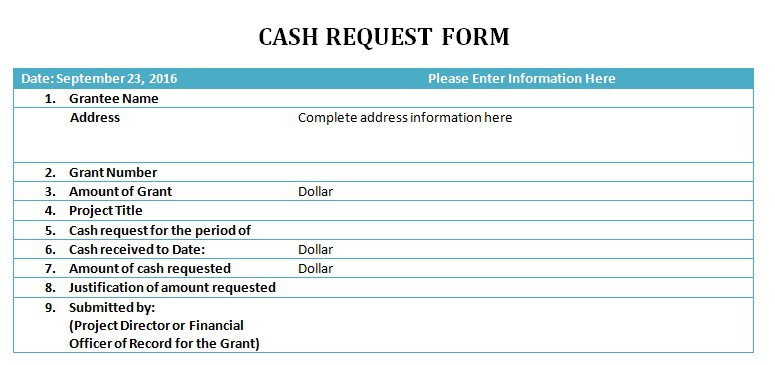
Preview the editable layout below, then download the template. Customize it to match your authorized workflow and keep the completed form with receipts and reconciliation records.

Cash Request Slip FAQs
What is a cash request slip used for?
It documents a request, approval, issue, and settlement of cash needed for an authorized organizational expense.
Is it the same as a receipt?
No. The request slip documents authorization and custody. A receipt documents the actual purchase or payment.
Who should approve the request?
An authorized person who can evaluate business purpose, budget, policy, evidence, and amount. Requesters should not approve their own requests.
What should happen to unused cash?
Return it promptly, record it on the settlement, restore it to the fund, and confirm that expenses plus returned cash equal the amount issued.
Can the form be used for reimbursements?
It can be adapted, but a separate reimbursement form is often clearer because reimbursement happens after someone has paid personally.
What if a receipt is missing?
Follow the organization’s missing-document procedure. This may require a declaration, explanation, manager approval, and additional review.
How are request numbers assigned?
Use a controlled, unique sequence, optionally including year, location, or fund code. Retain voided numbers and prevent duplicates.
Can requests be stored digitally?
Yes, if electronic approvals, access, retention, security, and signatures satisfy policy and applicable law.
How often should petty cash be reconciled?
Reconcile regularly based on risk and activity, and also at reporting cutoffs, custodian changes, or whenever a discrepancy appears.
Is this template accounting advice?
No. Confirm controls, tax treatment, classifications, and retention requirements with qualified professionals.